Module 11
Neurobiology, Physics & Ethics of Sighthounds
10 questions. Read the study material and complete step 1, then enrol for £31.25 (grading and certificate included) to unlock the rest. Progress is saved on this device, so you can leave and return at any time.
Study Material
Use the material below as a foundation for deeper research, then confirm you have read it to begin the assessment.
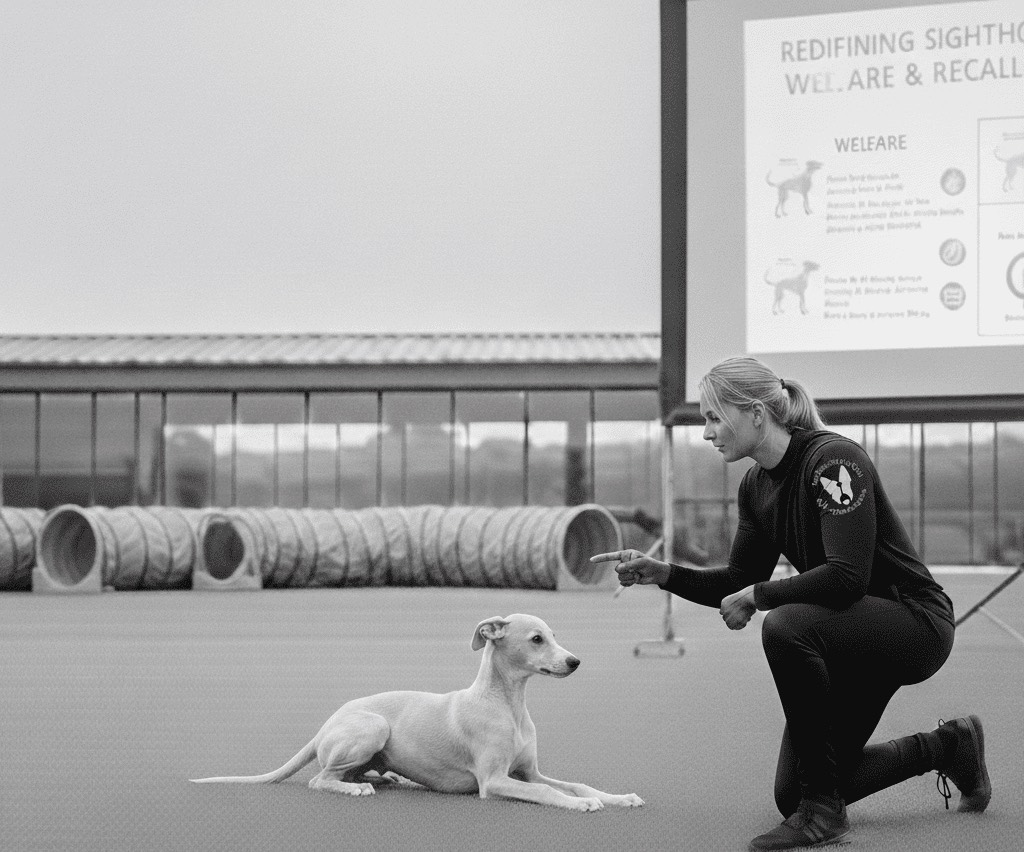
- Deaf to Your Voice: When a sighthound “locks on” to movement, the brain undergoes an intense shift. Sight is the dog’s main sense, and the visual cortex, the part of the brain that handles sight, takes priority. A hardwired chase sequence then fires faster than conscious choice. The dog can still hear, but the part of the brain that hears your voice loses out, so learned commands are overpowered in that moment. Not Defiance: At lock-on it is not a choice to ignore you; your voice simply does not get through, and even the conditioned tone can be ignored. That is why e-collar recall training uses the conditioned tone, backed by the tap, and gives the recall word the moment the fixation breaks. The Trainer’s Shift: Stop viewing the dog as “disobedient” and start viewing them as “mentally unavailable.”
Kinetic energy = ½ × mass × speed²
As speed increases, the energy involved in a sudden stop grows with the square of the speed: double the speed and there is four times the energy.
- Tactile vs. Kinetic: Tactile stimulation from a properly conditioned e-collar, at a correctly set level, acts as a physical “tap on the shoulder.” The tone is the everyday recall cue and the tap is the back-up. If a dog has already bolted in full prey drive, the handler presses the boost button at once: it skips the tone and uses a stronger level, set and tested in advance. No stim is ever used on a dog bolting in fear, boost or otherwise. The stim is always held, never a single split-second burst: the handler lets go the moment the dog turns and commits to coming back, and never presses it once the dog is on its way back. The Interruptor: The goal is to break the visual hyper-fixation before the dog reaches full speed, allowing the brain to switch back to a state where it can respond to a command. Safety First: This is used as a preventative communication tool, not a punishment for running.
- The Argument for Freedom: Sighthounds are built for speed and expansive movement. Denying this expression can lead to secondary behavioral issues and a lack of fulfillment. The Modern Dilemma: Is the “Positive Only” label worth the physical risk of a long-line injury or the mental toll of permanent confinement?
- Acknowledge the Biology: In full drive, a sighthound’s chase sequence overpowers your voice. The dog can still hear, but the channel that stays open is the conditioned e-collar: its tone, backed by the tap. Respect the Physics: Long lines can do far more physical damage than an e-collar’s tactile cue, because of kinetic energy, so they are never used. Prioritise Fulfillment: True welfare involves finding safe ways to allow a dog to be what it was bred to be.
Step 1 of 11